The Smell of Vulnerability. The Armor.
Part II: The Coping. Personal Field Note.
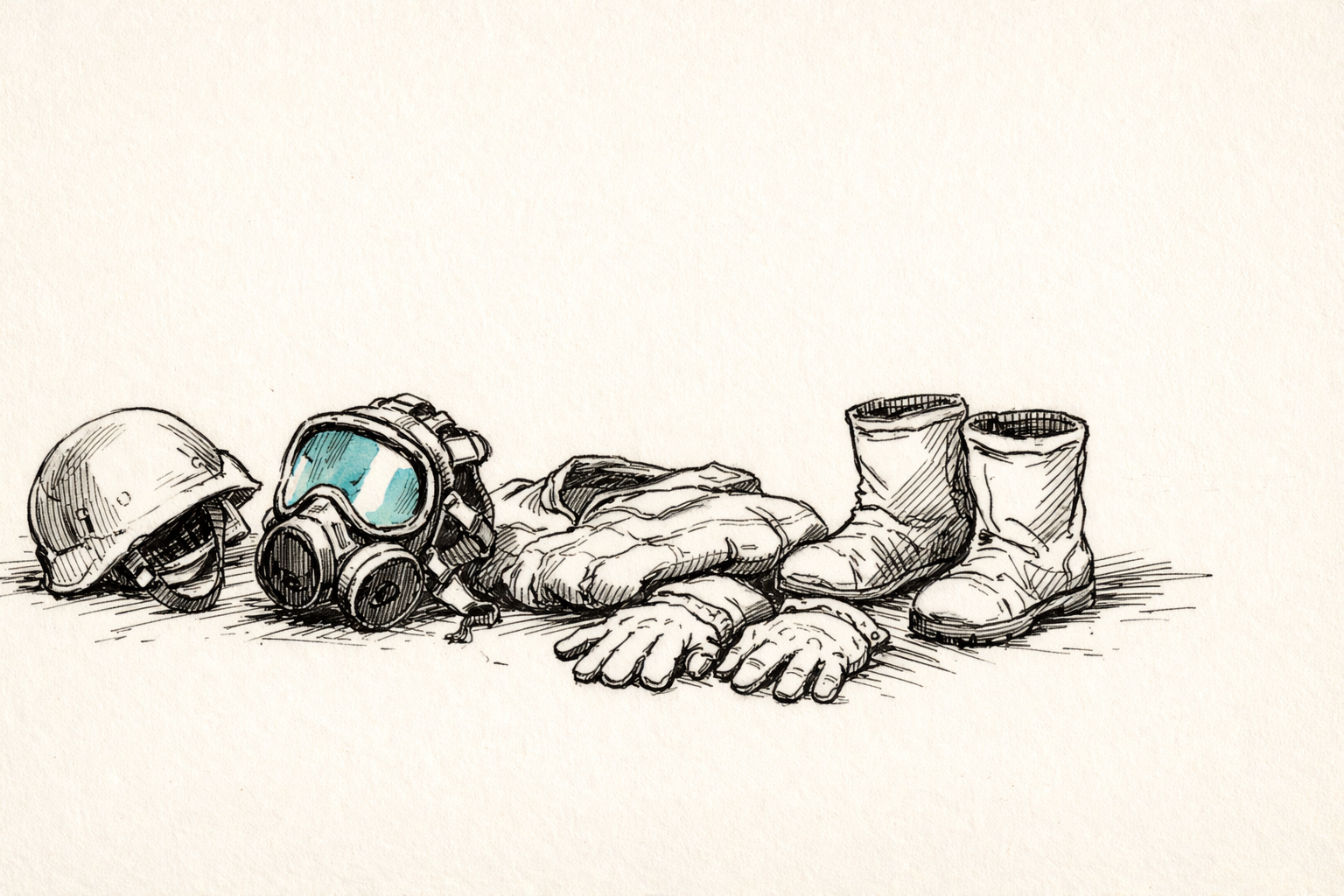
Business as usual.
The researcher Brené Brown says that without vulnerability, we cannot create. I agree. But I also know what vulnerability feels like in a workplace where it will be used against you.
Part I: Did I Get Fired?
The sharks start circling when they smell vulnerability. Each day before I walked into the office, I put on my armor to protect myself mentally and emotionally. The armor was invisible to others, but it was as real to me as the military protective gear I wore when deployed to a high-risk location. The protective clothing was designed to seal out harmful toxins. In full dress: a hard helmet, a wool cap, a full-faced gas mask, a thick heavy jacket with matching pants, thick gloves, and rubber boot covers. When everything was zipped, buckled, tied, and snapped, it was business as usual. Never mind the restricted breathing, the impaired vision, the muffled voice, the increased anxiety, and being unrecognizable to yourself. It was burdensome to carry every day. But exposure was so much more frightening.
And it works. For a while.
That’s what survival looked like for me. I built armor—emotional, psychological, and behavioral—and I put it on every morning. I learned to suppress. To perform composure. To be hypervigilant about every word, every facial expression, every email. I scanned the room before I spoke. I drafted and redrafted messages to remove anything that could be used against me.
And it works. The armor protects you. For a while.
Unrecognizable.
Here’s what I’ve learned from my research and from living it: the armor doesn’t just keep the toxins out. It keeps YOU in.
Over time, the protective behaviors that kept me safe started to change who I was. I became someone I didn't recognize. When I interviewed professionals years later, they described the same thing in almost identical language:
I lost my self-confidence when I used to be very confident.
I looked in the mirror and didn’t know who I was anymore.
I became short-tempered, hypersensitive, and preferred isolation.
I felt like a shell of a person.
The language was interchangeable. Mine and theirs. Across industries, cities, and generations.
That’s the part that doesn’t get talked about. We talk about toxic bosses. We talk about burnout. We rarely talk about the slow, invisible transformation that happens to YOU when you spend years armored up—how the very strategies that keep you employed also hollow you out.
I watched that happen to people. I watched it happen to me.
You are surviving.
If this sounds familiar, I want you to share two insights.
First: The armor was a rational response. You put it on because the environment demanded it. There is nothing wrong with you for having built it. You were surviving. That takes more strength than most people understand.
Second: Surviving is not the same as living. And at some point, the question shifts from “How do I get through today?” to “How do I get off the X?”
That second question is where the real work begins. It’s the question this community is built around.
In my next story, I’ll share the conversation that changed everything for me—when a friend asked the question I’d been avoiding.
Part III: Get off the X